Ordering:
The first production run of LP-PAN is
sold out. All orders received after the first batch cutoff will be
filled from the second run. I have already ordered parts for the second
run. This will include all Dayton orders as well. Expected shipping
date for run 2 will be approximately June 7.
Manual: Preliminary manual available.
Software
downloads: Required software for
integration with K3 includes PowerSDR-IF Stage and
either LP-Bridge or Ham
Radio Deluxe. Note: LP-Bridge
has not been released yet. There will be a new version of PowerSDR-IF
Stage released shortly which will provide the added features to support
LP-Bridge. I will release a beta version of LP-Bridge at the same time.
In the meantime, HRD will provide basic functionality for
point-and-click tuning and tracking the K3 for frequency and mode.
Updates:
Latest news about LP-PAN
LP-PAN FAQ
Important reading to address just what the LP-PAN can and can't do.
LP-PAN User Group
Join for latest news, feedback,
support, etc. This is the preferred
place to post questions and comments on LP-PAN. Please limit use of the
Elecraft reflector for LP-PAN specific questions.
System
Requirements
Sound Card Info
General Information:
LP-PAN
is a software defined IQ direct conversion panadapter project. It
is currently at the beta test stage, with ordering to follow shortly.
The production version will have a PCB similar to that
shown above, and a custom aluminum case with powder
coated finish and silk-screening. Pricing for a production version
is tentatively set at $175 kit / $225 assembled. Since I received the
K3, I have made a few minor changes to
optimize the interface to the K3, and have been busy working on some of
the software hurdles to integrating it fully. LP-PAN will work with
other radios with HF IF
frequencies as well, but is initially built to work with my K3. I have
also ordered a handful of xtals for use with the Kenwood 8.83 MHz IF,
though, as there seems to be some interest for that..
Here is
a list of current features...
* Optimized for K3
* Up to 192 kHz display on PC,
sound
card dependent
* Display centered on K3 IF
* Switching quadrature detector for
high dynamic range
* Strong buffer amp with very
high LO
isolation.
* Ground isolated inputs / outputs
with high quality audio xfmrs
* Fully balanced architecture
with balanced and unbalanced outputs
* Jumperable ground lift on
RF input and audio outputs
* Works with many SDR
programs.
* Point and click frequency
control
with PowerSDR / IF Stage and LP-Bridge or HRD
. In addition, LP-Bridge
allows sharing of
K3/LP-PAN with almost any logger, and
even programs
such as CW-Skimmer
* Will be available for other common
IF frequencies in the HF region as custom order in future production
runs.
* Powder coated aluminum enclosure with
silk screened graphics.
* Hardware or software mute
Here are current specifications (sound card dependent... measured with
E-MU 0202 USB sound card)
* Approx. -130dBm noise floor with K3 preamp on
* +5dBm maximum input with K3 attenuator on
* 115dBm dynamic range
* Approx. 60dB image rejection
over
192 kHz
span with PowerSDRTM (higher over 96 kHz span) , 90dB+
with Rocky.
* Excellent THD and IMD performance
*
+22dBm IP3 (composite value
for K3/LP-PAN combo)
* THD ~ 0.005%
* 600 ohm output Z, balanced
or
unbalanced.
* +2dBV (1.27 Vrms, 3.6V p-p) nominal output level at
recommended maximum RF input
* Adjustable gain to interface almost any sound card
* 8215 kHz L.O.
* 11-16 VDC @ 45 mA
Note: Specifications dependent on
sound card, and subject to change.
Cited values were taken with an E-MU 0202 USB sound card. All
measurements also apply to M-Audio Firewire Audiophile 2496 card
(limited only by 96 kHz display width). Measurement
details
are included in the Performance section below. PowerSDRTM
is an
open source application for use with IQ based software defined radios,
and is a
trademark of FlexRadio Systems.
Hardware:
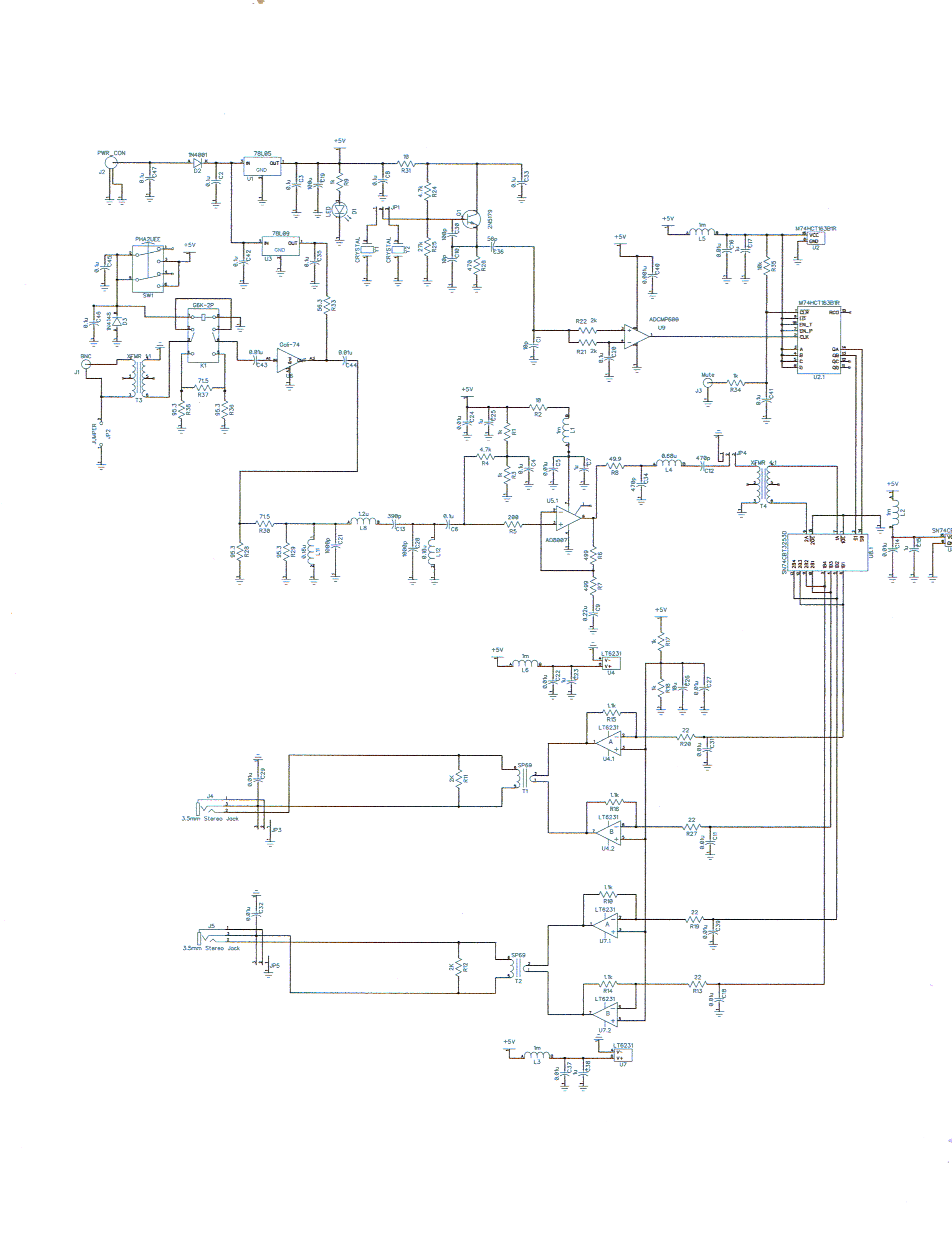
LP-PAN consists of a multipole bandpass filter, followed by a
strong
buffer amplifier with high isolation, followed by a balanced switching
mixer. The output of the mixer is fed to two pairs of balanced low
noise op-amps with ultra wideband 600 ohm output transformers for
flexibility
in sound card interfacing. The L.O. in LP-PAN runs at 8.215MHz,
providing an output of 0Hz at the K3's IF frequency. I have also tried to maximize interfacing
flexibility with the
sound
card, to minimize hum and noise issues there. The devil is in
the details, and that is where I have concentrated my efforts to make
LP-PAN the best integrated panadapter solution for use with K3.
Software:
LP-PAN can be used with
most SDR decoding applications, like PowerSDRTM,
Rocky, SpectraVue, Spectrum Lab, etc. With PowerSDRTM and Ham Radio
Deluxe, point and
click frequency tuning is available, thanks to Scott, WU2X's customized
version of PowerSDR called PowerSDR/IF Stage (http://www.wu2x.com/sdr.html#powersdr). The pictures in the performance section
below are taken from PowerSDRTM. I am working on a bridging program which
will allow simultaneous use of PowerSDR and any logger or other program
which requires a K3 interface. More on this below in the section on
LP-Bridge. LP-PAN will also
work
with other programs which will decode an audio IQ signal, like the
nifty CW Skimmer from
Alex, VE3NEA. Here is a portion of a CW Skimmer screen capture...

Another nifty thing I have been playing with is using the waterfall
display in PowerSDR to provide a CW Skimmer type display. The advantage
is that you can see the entire CW band, or zoom into a small section.
Below is a screen grab at a fairly wide setting. Of course, you could
zoom into any section and click on a stream to tune to it. Scott thinks
he can provide a signal ID for each of the streams based on web
cluster info, and Alex is planning to export band map data I believe.
Wouldn't that be spiffy? Some of these software
ideas are in the early stages, so the usual disclaimers apply.

LP-PAN allows you to use your
PC / sound card as a second receiver with
lots of nice features if you use the PowerSDRTM app. PowerSDRTM has lots of flexibility in terms of
modes, bandwidths, interference reduction tools, etc. I find listening
to SW broadcasts with the synchronous AM detector very nice.
Here is the first cut at the LP-Bridge program. It will do several
things. 1) It will provide a method of allowing several applications to
simultaneously share bidirectional communications with the K3 by
creating virtual ports for the other
applications to connect to... 2) It will provide a means to obtain
offset data from the K3, and pass it along to WU2X's IF Stage version
of PowerSDR... 3) It provides a convenient way to implement
point-and-click tuning from PowerSDR /IF Stage by providing an
extensive direct DDE interface to PowerSDR. Here are some reduced size
screen grabs. Views are normal, normal with K3 status and setup /
diagnostic view.

It is a work in progress, but I have it working with one serial com
port and three virtual com ports. Setup allows you to add an
application
name to go with each virtual com port to keep things straight. Typical
choices would be a logger and maybe a PSK application or something like
CW Skimmer... any application that requires serial communication with
the K3. Time will tell about throughput issues, but I can't tell any
difference between a direct K3 connection and one through the virtual
port bridge. To maximize throughput, all normal polling is handled by
LP-Bridge. Polling requests from the applications is responded to
directly by LP-Bridge, from a "virtual K3" mirror, preventing
collisions from multiple requests to the K3 from various programs.
Handskaking lines for CW and PTT keying are passed through to the K3.
Muting of PowerSDR is fast enough
using LP-Bridge for VOX and semi breakin CW keying. A hardware mute
input is also provided on LP-PAN if faster muting is needed forspecial
modes.
In addition, I am considering a totally new, dedicated panadapter
display which will replace PowerSDR and also integrate the LP-Bridge
capability. I have the display, sound card interface and rig control
portions from other programs of mine, but I need to either find a
plugin component for the DSP decoding, or learn to do it myself. That
might take awhile ;-)
Performance:
Note: All test results were obtained
using an E-MU 0202 USB sound card. Similar results can also be obtained
with the M-Audio Firewire Audiophile card (limited to 96 kHz
sampling and display width).
Usable Dynamic Range:
Below is an example of LP-PAN
working with PowerSDRTM. There is no
distortion visible at a level of -20dBm (~ S9 + 53dB) from my HP-8640B
signal generator. Increasing the
level to -10 dBm (~ S9 + 63dB), about 5 dB before clipping, a couple
small
distortion products
appear
about 10-15 dB above the noise floor. The average noise floor is
about
-120 dBm (~0.2uV for 10dB S/N)
in this setup. This test was run with the K3 preamp OFF.
Noise floor with the preamp ON is about 10dB better. The smaller blip
is the image, which is almost 70dB down. Image
rejection runs about 70dB within +/- 48kHz of center, and
decreases to about 55dB at the +/- 96 kHz edges. This level of image
rejection is acheived with no "learning" software needed. With programs
like Rocky which can learn the phase/level errors, the image
rejection is 90-100dB.
When
connected to the K3, LP-PAN provides almost 115dB dynamic range between
noise floor and clipping. Here are the approximate ranges.
Preamp On... -15dBm / -130dBm
Preamp Off... -5dBm / -120dBm
Attenuator On... +5dBm / -110dBm
These figures should provide a reasonable compromise between signal
handling on the lower HF bands and MDS on the upper HF bands. It would
be possible to add an additional choice by adding a gain switch which
could reduce gain another 10dB. That might be something of value to
Europeans, only time will tell. For now, +5dBm is way higher than any
signals I have seen. I have been in talks with Elecraft about possibly
modifying the K3's internal IF buffer amp to reduce loss. If this
happens, I may opt to stay with the added sensitivity, or reduce gain
in LP-PAN to maintain these ranges, depending on what feedback I get on
maximum signals being experienced in the field. If I lower the gain, it
would require replacing one SMD resistor in LP-PAN (or adding an
external 10dB BNC pad)..
Image
Rejection:
The one parameter that is
difficult to maintain over a wide bandwidth (2.5% in the case of the
K3) is image
rejection. There are a number of reasons for this, and greatly
improving it would be beyond the scope (and cost) of this project I
think. Some SDR apps,
like Rocky and M0KGK's
KGKSDR, provide automatic gain/phase balance tracking... but
this is not the case with PowerSDRTM, which only allows for
manually optimizing of the balance at one frequency. Scott is looking into adding Rocky style
automatic image nulling to his version of PowerSDR. This will be a
welcome development, but even without it, image rejection is excellent
with LP-PAN, especially over a 96 kHz display..
The above display shows typical image rejection, and this level can be
expected over most of the 180 kHz+ display. Here is a summary of
measured
image rejection...
PowerSDR, varies from 55-70dB over 192kHz, >60dB over 96 kHz span.
Rocky, 90-100dB over 96kHz span
Rocky doesn't support 192kHz sampling. Image
rejection is somewhat dependent on the input impedance of the sound
card, which is why the output impedance of LP-PAN was intentionally
kept low (600 ohms). I have added a load balance pot to optimize image
rejection with different sound cards, but this may be overkill. Here is
a picture of the
gain/phase balance measurement screen in Rocky
over a 96kHz bandwidth. This shows LP-PAN has a fraction of a degree
phase error, and a fraction of a percent gain error. This accounts for
the image rejection numbers I'm getting.

These image rejection numbers
indicate that an
S9+20-30 dB signal will have no visible image on the display. In
practice, tuning around the bands, I don't see any images on anything
but very strong SW BC stations. In fact, the strongest signal I have
seen so
far is less than -20dBm (S9 + 53dB) on 40m at night. Most strong
signals are in the
range of -40dBm (S9 + 33dB).
Blocking Dynamic range (BDR):
To test the BDR
performance of the LP-PAN / PowerSDRTM combo, I set up the following test...
I fed my K2 and HP-8640B signal generator into the K3 through a hybrid
combiner. These sources both have good phase noise characteristics.
Because the HP is an analog generator, it is a little better than the
synthesized K2, so I used it as the interfering signal. I set the
signal generator
for -7 dBm, which produces a -10dBm (S9+63dB) signal to the receiver,
and set the K2 (with attenuators) to produce a -100dBm (~3uV) signal. I
set the BW
on PowerSDR to 400Hz, and tuned in the weak signal. I slowly slid the
signal
generator toward the weak signal to see how close I could get before
affecting the weak signal. I found that I could get within
5kHz before noticing any indication of the adjacent strong signal, and
that was only that I could hear the noise sideband of the signal
generator. I didn't notice any AGC desense at all. I then reduced the
"interfering" signal to minimize the effect of the sideband noise. At
-55dBm (S9+18dB), I couldn't hear any effect of the interfering signal
at <1 kHz. The screen captures above represent 5 kHz, 2 kHz
and
~800 Hz. It appears that BDR is mainly limited by the quality of
the interfering signal.
Third order IMD:
Above is a picture showing the IMDR3
performance with two signals separated by 5 kHz. The carriers were
supplied by my HP 8640B signal generator (right),
and my K2 feeding an adjustable attenuator (left). The two signals were
combined in a Mini-Circuits JPS-2-1 hybrid combiner. The combiner
output was fed to the K3 RX ant input.
The above picture shows the
composite
IMDR3 performance of the K3
and LP-PAN with the K3 preamp off. The pictures
were
taken with an input level of -15dBm (S9+58dB) for each of the two
tones... total
input of -9dBm (S9+64dB). The display shows 3rd order distortion
products about 75dB
down from each
carrier. The calculated IP3 is +22dBm. Measurements taken at 2kHz
spacing yield virtually identical results, but are more difficult to
see because of the phase noise of the K2..
L.O.
leakage / isolation:
Because LP-PAN connects to an unprotected IF port on the
radio, it is important that any LO leakage in the rig's passband be
very low.
This is something I spent a lot of time on in design and testing. As a
result, the measured LO signal at the input of LP-PAN is -135dBm
(~0.05uV). Adding in an
estimated 20dB+ isolation for the buffer in the K3, this should be a
more than adequate amount of isolation to prevent any
issues with the
K3. In my initial testing, I have not been able to detect LP-PAN's LO
in my K3, confirming that the leakage is below the noise floor of the
K3. For comparison, the LO
leakage of a couple SoftRock
receivers that
Jack, K8ZOA and I checked, measured about -40dBm (S9+33dB)...
almost 100dB higher than the buffered LP-PAN.
I also added more filtering to the input of LP-PAN to filter out the
numerous spurious signals I found in the K3 IF output once I got my
rig. These signals include LO leakage from the K3, plus harmonics and
mixing products of them. The picture on the left shows the K3 IF output
with one signal in the passband with about an 80 MHz span. The second
picture shows the same conditions with my filter installed. In
practice, I see a number of products sliding through the panadapter
display as I tune without the filter, but none with it.

Here is the response of a
breadboarded version
of the filter. I could probably reduce the bandwidth, but at the
expense of loss and ease of tuning.The K3 already has more loss than I
would like from antenna jack to IF output, and I am being careful not
to add to it. I think this filter is appropriate for
the application, and should be more tolerant of component variations,
although it remains to be seen if I can avoid having to tune each
filter. I will use variable caps and precision SMD coils on the beta
units, but hopefully will
be able to do away with the variable caps on the production versions.
Audio
Interfacing:
To minimize installation problems, I
added transformer coupling of the IF port and high quality audio xfmrs,
all with "ground lift" jumpers
to
minimize hum and noise in the audio interface. Audio output is 600 ohms
to allow driving any sound card, and one channel has an adjustable load
to balance out any termination variations in the sound card / cabling.
This level of detail is required to acheive the image rejection that I
am able to get, which rivals a superhet with xtal filtering when
carefully adjusted, in my installation anyway. The outputs can also be
used in
either balanced or unbalanced mode for further isolation when a
professional sound card with balanced inputs is available. As the
PowerSDR screen shots show, there are no spurious
hum or noise signals from the audio interface in my installation...
even at the 0 Hz center frequency.
Using LP-PAN as a spectrum analyzer:
One of the more useful pieces of test equipment for ham use, but also
one of the more expensive, is a spectrum analyzer. An example of a good
use of LP-PAN in this regard is a project I worked on recently. I was
asked by the FDIM
organizers to build and test their 2008 Buildathon
project, a 10W QRP amplifier for CW/SSB. I have a Tektronix 7L13
spectrum analyzer, and normally use this for testing spurious emissions
like harmonic suppression and IMD. The
Tek works great for checking harmonics, and IMD with fairly wide tone
spacing, but is not so good at displaying IMD with 1200 Hz tone spacing
as
is commonly used to check SSB amplifiers.
Below are displays from the Tek with tones spaced 20 kHz, and LP-PAN
with tones spaced 1200 Hz. You can see where the resolution bandwidth
of LP-PAN/PowerSDR is quite welcome. The same would hold true for other
decoding applications like SpectrumLab or SpectraVue. The panadapter
display could actually be zoomed in much more if needed These pictures
were not taken under the same conditions of drive level, so cannot be
compared
directly, but you can see the similarities. Looking at 20 kHz spaced
tones on LP-PAN results in traces that are thin vertical lines because
of the enhanced resolution bandwidth.
If the transmitter output is attenuated to about -20dBm, the distortion
of the K3 and LP-PAN can essentially be ignored, as it will be below
the
noise floor. This guarantees that the testing hardware will not color
the results. It still leaves at least 80dB of measuring range, which is
comparable to a professional spectrum analyzer.
Note:
All test results were obtained using an E-MU 0202 USB sound card.
Similar results can also be obtained with the M-Audio Firewire
Audiophile card (limited to 96 kHz sampling and display width). Other
cards are being tested.
Pricing
and ordering...
Note: Expect about a 3 week delay in shipping until I can get caught up.
Note:
All prices in
$USD. Standard
US shipping charge is $10 for Fedex
Ground or USPS Priority Mail - 2 to 4 days.
INTERNATIONAL:
A
1% currency exchange
fee will be added to overseas orders. For
overseas orders, custom orders or items not shown below, use the
following guidelines,or email
us for quote. Proper
documentation is provided,
including correct harmonized code to avoid duties where applicable.
Customs
documents require an accurate value, and usually copies of the
invoice. Please don't ask us to falsify these documents!
Canada, Mexico:
LP-PAN kit = $176.75USD
LP-PAN assembled = $227.25USD
USPS Priority Mail, 6-10
days,
insured, trackable online... $19USD
USPS Express Mail, 5 days, insured,
trackable online... $24USD
Europe:
LP-PAN kit = $176.75USD
LP-PAN assembled = $227.25USD
USPS
Priority Mail, 6-10 days, insured,
trackable online... $28USD
USPS Express Mail, 5 days, insured, trackable online... $36USD
Australia, New Zealand, Japan, Singapore, Hong Kong:
LP-PAN kit = $176.75USD
LP-PAN assembled = $227.25USD
USPS
Priority Mail, 6-10 days, insured,
trackable online... $29USD
USPS Express Mail, 5 days, insured, trackable online... $32USD
APO:
USPS Priority Mail. Use US Order buttons below (and thanks for your
service).
Others: email us for quote.
In general, I recommend Express Mail. I have sent hundreds of LP-100s
overseas using Express Mail and have never had a problem. Payment can
be made at www.paypal.com. Our PayPal address is larry@telepostinc.com.
For credit card or other payment methods, email us.
Price List for US Orders Only:
For
orders outside US, please read above international ordering section.
US
ONLY
| LP-PAN Kit: Includes PCB with
pre-installed SMD parts, powder coated aluminum enclosure with
silk-screened graphics and power cable with tinned leads. Audio cables
depend on sound card used, and are available at local outlets such as
Radio Shack. Manual will be available online. LP-Bridge software is
also included and will be available online as well. Tentative beginning
ship date is May 7, 2008. |
$175.00
|
|
| LP-PAN Assembled: Includes powder
coated aluminum enclosure with
silk-screened graphics and power cable with tinned leads. Audio cables
depend on sound card used, and are available at local outlets such as
Radio Shack. Manual will
be available online. LP-Bridge software is also included and will be
available online as well. Tentative beginning ship date is May 7, 2008. |
$225.00
|
|
For overseas orders, please see
above international ordering section.
Payment
can also be made by credit card
at
734-455-3716, or regular mail at:
TelePost Inc.
49100 Pine Hill Dr.
Plymouth, MI 48170
NOTE: PayPal orders are processed immediately, even if shipment is a
few weeks away. Credit card
orders placed by phone won't be processed
until shipment is imminent.
Frequently Asked Questions
1.
What is LP-PAN?
A direct conversion receiver with quadrature detector to provide I and
Q audio signals for connection to a sound card. It is designed to
receive a range of frequencies centered on 8.215 MHz, the IF frequency
of the K3. By using quadrature detection,
a total bandwidth equal to the sampling rate is obtained, ie. 192 kHz
sampling will give almost +/- 96 kHz tuning range, etc.
2. Does LP-PAN require a PC?
Yes. A PC and sound card are required to use LP-PAN. Suggested PC
configurations are given above in the General Information section. They
are similar to what would be required with any SDR type radio
application. The software application does the IQ decoding and provides
a spectrum display, second receiver, etc.. Other applications, like CW
Skimmer provide other functionality. See Software section above.
3. Will LP-PAN work with a Mac or Linux?
LP-PAN depends on the use of an SDR application. There are a number of
these around. The most popular is probably PowerSDR from FlexRadio,
which is an open source application, but a quick search doesn't reveal
a version for Mac. I don't know what options there are for a CAT
interface / logging program using platforms other than Windows. I plan
my own dedicated
application with specific K3 oriented features, but it will only be for
Windows. You might consider Wine or Parallels or VMware, or using a
dual boot configuration. Make sure your sound card is supported though,
especially if it's Firewire based.
4. How does LP-PAN interface to the K3?
It connects to the IF output. You will need the KXV3 option for the
K3. The K3 also needs to connect to a PC serial port to provide
frequency data to the SDR application if you want the display to show
actual tuned frequency. LP-Bridge will allow interfacing the K3 to
LP-PAN and several other programs at the same time for full
bi-directional serial control from all applications, without adverse
interactions, and with very easy configuration in one
simple program.
5. Can LP-PAN be used without a serial interface?
Yes. The program can be set up to display relative frequency referenced
to an arbitrary center frequency, like 0kHz or 8.215 MHz. To use point
and click tuning, or to display actual receive frequency, a serial port
connection is required.
6. What software is required for point-and-click tuning with the K3?
This is currently available using the PowerSDR-IF Stage sub-version
that Scott
WU2X has written along with HRD (see discussion
earlier on this web page in the Software section). There is still an
issue about offsets. K3s with 5 pole filters use an offset to adjust
for filter variations. In other words, the IF is not exactly at 8.215
MHz with those filters. Wayne at Elecraft has indicated that he will
make the offset data available through a serial port command. This will
also come in handy to keep PowerSDR centered as the IF shift and Hi/Lo
Cut controls are adjusted. The offset information is needed because the
K3 LO is offset when adjusting these controls, and results in the
passband at the IF output port being shifted slightly. LP-Bridge
will provide an extensive link to Scott's PowerSDR-IF Stage
program, and simultaneously allow bidirectional communications with
several other programs at the same time.
7. Will LP-PAN be sold as a kit or as an assembled unit?
LP-PANis available both as a partial kit (with
pre-installed SMD parts) or fully assembled unit. Kit builders will
need to adjust the input bandpass filter, but I have designed the
filters to allow this to be easily done. The resulting adjustment
should provide a passband flatness of about 1dB. If the builder wants
it better than that, he can send the unit to the factory (with pre-paid
return shipping) for the adjustment. This takes only a couple minutes
to do using my HP VNA. I haven't seen any obvious advantage to factory
tuning, but it could affect image rejection slightly I suppose.
8. What is required to connect LP-PAN to my K3 and PC?
A 50 ohm coax cable with BNC connectors to connect LP-PAN to the K3 IF
output. For audio, a pair of balanced or unbalanced cables with 1/8"
mono/stereo phone plugs on
the
LP-PAN end, and appropriate connector(s) / adapters on the sound card
end is
required, depending on the sound card. Also, a
source of 11-16VDC @ 40mA. LP-PAN is supplied with a power cord with
2.5mm DC connector on one end and tinned leads on the other. It can
easily be powered by the accessory 12VDC output of the K3. An RCA "PTT"
type jack is provided for muting PowerSDR during transmit. This is only
needed if you find that the software muting provided by LP-Bridge isn't
fast enough for the modes you use. The Mute input requires a short to
ground to mute, and no more than ~ 7VDC when not muted. For safety, an
isolated relay or open source transistor driver is recommended.
9. What features does LP-PAN offer besides a spectrum display?
Spectrum/panadapter display is only one feature that can be used with
LP-PAN. Features are application dependent, and vary from program to
program. I have played mostly with Rocky and WU2X's IF version of
PowerSDR so far. In addition to the panadapter display, I have used
LP-PAN as a second receiver for SWL'ing. PowerSDR has a nifty
synchronous AM detector that makes SW listening a pleasure. It can also
decode digital voice modes and a host of other things. As a receiver,
it performs very well. See the performance section above. I have also
played a bit with VE3NEA's very clever CW Skimmer program, which allows
you to see dozens of decoded CW signals at a time for a section of the
band, and it displays callsigns and RST reports for all the stations,
plus a decoded message section for the signal you are listening to.
10. Can LP-PAN share a sound card with other applications?
This can be done with the low cost VAC (Virtual Audio Cable) program,
but there are a couple problems with this approach. One has to do with
resampling of the audio signal and resultant artifacts. Another is that
you may want to feed the K3's audio to
the other applications instead of LP-PAN's audio. I recommend a
dedicated new card
for LP-PAN to get maximum
bandwidth, resolution and overall performance. The card I am using is
an external USB sound card, and easy to add to any
system. An inexpensive
(probably built-in) sound card would suffice for the secondary sound
card. I have also done some preliminary testing of the sound card built
into the microHam MicroKeyer II, and it seems to coexist with the
LP-PAN's sound card without problems. Some applications can share the
sound card without any special programs, as long as PowerSDR and the
2nd program are set to the same sample rate, and the WDM driver is used
for both. There may be other ways to do this as well, but I have done
this one successfully.
11. What sound cards give the best performance?
I have only found one good 192kHz card at reasonable cost, and in fact
there
are damn few at any cost. This is the Creative Labs E-MU 0202 external
USB
sound card. It also
provides 24-bit depth. All other cards I saw that claimed to be 192 kHz
had problems,
or only used that sampling rate for output (playing music, etc.) LP-PAN
requires a card that also can "record" at 192 kHz. The E-MU card lists
for
$150, but I paid about 60% of that price for mine, plus shipping. If
you
can be happy with a 90 kHz wide display, there are some good
24-bit/96kHz
cards around. The M-Audio Audiophile 2496 PCI card works extremely
well, and the professional Delta44 is good with one caveat. See the Sound Card Info page for more
details. For Firewire interfaces, I have found two acceptable cards.
The M-Audio Firewire Audiophile is excellent up to 96 kHz, and the
Edirol FA-66 works well up to 192 kHz sampling, but usable display
bandwidth is about 150 kHz. There is another caveat as well, and you
can read about it on the Sound Card Info page as well.
12.
Do I need to be a computer expert to get this all working?
No, but it helps! LP-Bridge is very easy to install and use, but
PowerSDR is fairly complex, and then there is the issue of installing
the sound card drivers, etc. HRD is large, but easy to install and use
as well. It really helps to thoroughly read the manual in advance of
ordering.
13.
Can LP-PAN be used with rigs other than K3?
From an RF standpoint, LP-PAN can be used with any rig that has an IF
output port with a signal pick off point before any narrow band
filtering. The IF also has to be in the HF range, generally 10 MHz or
lower. For these reasons, rigs which use an upconverting design with a
VHF 1st IF are generally not usable, even if an IF output port is
added. Most of these designs have a 20-40 kHz wide "roofing" filter at
the 1st IF, which limits the bandwidth available at later, lower IF
frequencies. If your rig doesn't have these limitations, but requires
the addition of an IF port, Jack Smith, K8ZOA makes a low cost buffer
amp PCB available to facilitate this. His website is
www.cliftonlaboratories.com.
From a control standpoint, you can control most rigs with a combination
of Ham Radio Deluxe and PowerSDR-IF Stage. This will not allow multiple
applications to control the K3 simultaneously as you can with
LP-Bridge, however. Currently, LP-Bridge only works with the K3 and
Kenwood, but there are plans to support other rigs.
Email me for
more info.
73,
Larry N8LP
Updates:
(6-28-08)
Run 2 is sold out, and run 3 is underway.
I shipped 25 units from run 2 this week. Run 3 will have a couple minor
changes. The LO has been shifted by 6 kHz to help make the unit more
usable with existing internal sound cards by moving 0 Hz response
errors of the sound card out of the passband. I am also trying to
finish up LP-Bridge. I have added automatic collection of all available
K3 IF offset data part of the program, which will eventually allow for
plug'n'play operation as far as offsets go. This will make configuring
the software MUCH wasier and less confusing. There are some pics of the latest
LP-Bridge software in the Software section of this webpage.
(6-24-08)
Run 2 shipments began this week with the
first dozen units shipping today. Work is continuing on LP-Bridge, but
Scott is still working on a bug in ver. 0.92 of PowerSDR-IF Stage.
I am planning on a change in run 3 to add
a small offset to the LP-PAN L.O. to help users with internal sound
cards which may have issues with response at 0Hz.
(6-19-08)
All LP-PANs from the 1st run have been
shipped. I have only a few left to sell from the 2nd run, and have
already ordered parts for the third run. I am still running a few weeks
behind orders for shipping, but I'm closing the gap ;-) Scott has sent
me an alpha of IF Stage v0.92, and I plan to post an LP-Bridge beta
this weekend.
(6-14-08)
All kits ordered before May 4 will have
been shipped by Monday, June 16, and all assembled units ordered by May
4 will be shipped by Wednesday, June 18. This will complete the first
run of
100 units. I received the enclosures for run 2 this week, and will
seamlessly move into run 2 after Wednesday. I have about 15 units left
to sell from run 2 as of this posting.
On the software front, Scott is working out a final bug in the next
release of PowerSDR-IF Stage, and as soon as he does I will test it
with LP-Bridge and release a beta.
Please be patient. In addition to LP-PAN, I have had about 60
orders for LP-100A since just before Dayton, and have to find time to
work on the software for LP-PAN as well as other products. I expect to
be all caught up on everything in the next month or so.
(6-13-08)
LP-PAN is featured in "What's New
at Dayton 2008?" on page 51 of the July 2008 QST. Here's a scan of the
article.
(5-12-08) Above are pictures
of the final LP-PAN. I
received the enclosures
Friday, and the pre-assembled PCBs today as expected. I built two units
for testing and they appear fine. I will package as many kits and
assembled units to deliver to Dayton as time permits. If I run out of
time, I will give priority to overseas orders. I will ship packages off
to the assemblers tomorrow to do the assembled units, and should be
able to ship a good percentage of the first run orders next week, both
kit and assembled varieties. I expect to ship all first run units
within a two week period. I should have a manual ready sometime next
week as well.
(5-06-08) I have all the
parts for the first run on
hand now, and expect both the pre-assembled PCBs and enclosures by
Friday. Since I have other things to get ready for Dayton, I will only
be able to prepare a few LP-PANs for delivery at Dayton, with the
balance to ship starting Monday 5-19. I expect to ship all ordered kits
that week, and assembled units starting the following Friday.
(4-30-08) The first
production run is almost sold out. I will be doing another run right after
Dayton. I ordered the PCBs
for the first run on 4-28, and expect to receive them on 5-5. I also
expect to receive
the enclosures sometime next week. I expect to receive the populated
PCBs on about 5-12, just a few days before Dayton. I plan to bring
enough kits to Dayton to deliver to everyone who asked about picking up
a prepaid unit there. Hopefully I will be able to bring enough
assembled units as well. I will give priority to overseas orders if I
can't assemble enough before the show to meet all requests for pickup
at the show.
(4-18-08) I have added an ordering
section to this page today. I contemplate shipments of LP-PAN to
start in 2-3 weeks, barring any unforeseen parts availability issues.
Enclosures are in production this week and next, and I should hopefully
have pictures of a completed LP-PAN at the end of next week. Two
versions of LP-PAN are available... partial kit and assembled. The
partial kit has all SMD parts installed, and the estimated assembly
time is 2-3 hours. Calibration requires peaking of two trimmer caps
while monitoring the PC display.
(4-09-08) I shipped two more beta boards today. I
also sent a test version of LP-Bridge to Scott for testing with the
next revision of his PowerSDR-IF Stage program.
(4-01-08) I shipped five beta boards today. I will
ship another couple after I replenish my parts bin of a few parts. I
hope to have some feedback this weekend, and will work on getting a
version of LP-Bridge out early next week.
(3-29-08) I have built five beta boards now and
tested them. I plan to ship them early next week. Here is a picture of
a finished board...

As can
be seen in the photo, there are no toroids in this design. All coils
and xfmrs are SMD, for ease of assembly. I added extra pads to allow
substitution of hand wound toroids if necessary based on availability
of the SMD parts at the start of each production run. There are some
extra pads on the beta boards, which was done to allow
me some experimentation. These will be deleted in the production
boards, except for the extra toroid pads.
(3-22-08) Above I have added a picture of the
completed beta board installed in the prototype enclosure. I have fine
tuned a couple of circuits and fixed a couple incorrect traces on the
PCB. I have also added a hardware mute input. I have updated some of
the screen captures in the performance sectio to reflect improvements
in performance. I think I have solved the problem of tuning for kit
builders by reworking the filter design a little bit. Tuning would
require a noise generator, like the Elecraft NGEN. I may also add a
noise generator to the PCB and jumpers to enable it, but this won't be
in the current run.
(3-19-08) I now have LP-Bridge communicating with
PowerSDR over the DDE interface, and should have a working program for
beta testers some time next week, with most of the planned
functionality in place. I still need to add the filtering and collision
prevention for the virtual ports, but all the basic pieces are working
now.
(3-18-08) I have received the prototype enclosure
from TenTec (pictured above), and will have the revised PCB tomorrow. I
should be able to ship the revised boards to the beta testers this
week. Barring any unforeseen difficulties, I should be able to take
orders next week and place the order for the first production run at
the same time. Deliveries would begin a few weeks later.
(3-12-08) I have the parts on hand for the five
beta boards, and should have the revised PCBs in a week. LP-Bridge is
coming along fine, with three working virtual com ports now. I took
some time off to build a project for the FDIM Buildathon, and test it
for them. See the new section about using LP-PAN as a spectrum analyzer.
(3-6-08) I have approved the
blueprints from
TenTec on the enclosure, and expect to have a prototype in a couple
weeks. Production enclosures should be ready 4-6 weeks after that, but
I may go ahead and start shipments of LP-PAN before the enclosures are
ready, with the enclosures being sent as a follow-up for those who are
eager to play with LP-PAN.
I have added the "final" changes to the PCB layout, and ordered parts
for five beta units. I changed the audio outputs to a pair of outputs
which can be switched from unbalanced to balanced, along with ground
lift jumpers for both outputs. This should provide plenty of options to
find a minimum hum/noise audio interface to most sound cards, either
consumer or professional level.
I should be ready in about a week for beta testing. I now have
LP-Bridge working with three virtual ports, and may add more after I
get beta site feedback. I am now working on the PowerSDR link from
LP-Bridge.
(2-20-08) I have updated the
image rejection and
IMDR3 specs after making some changes. Image rejection is now 50-70 dB
with PowerSDR, and 90-100dB with Rocky across the entire 192 kHz
bandpass... even better for 96 kHz bandpass. Even with PowerSDR, now,
images
for most strong signals are at or near the noise floor. By further
improving the QSD lowpass filter, and maybe adding variable loads for
the output transformers, I think I can get another 10dB or so for
programs with fixed image rejection asjustments like PowerSDR.